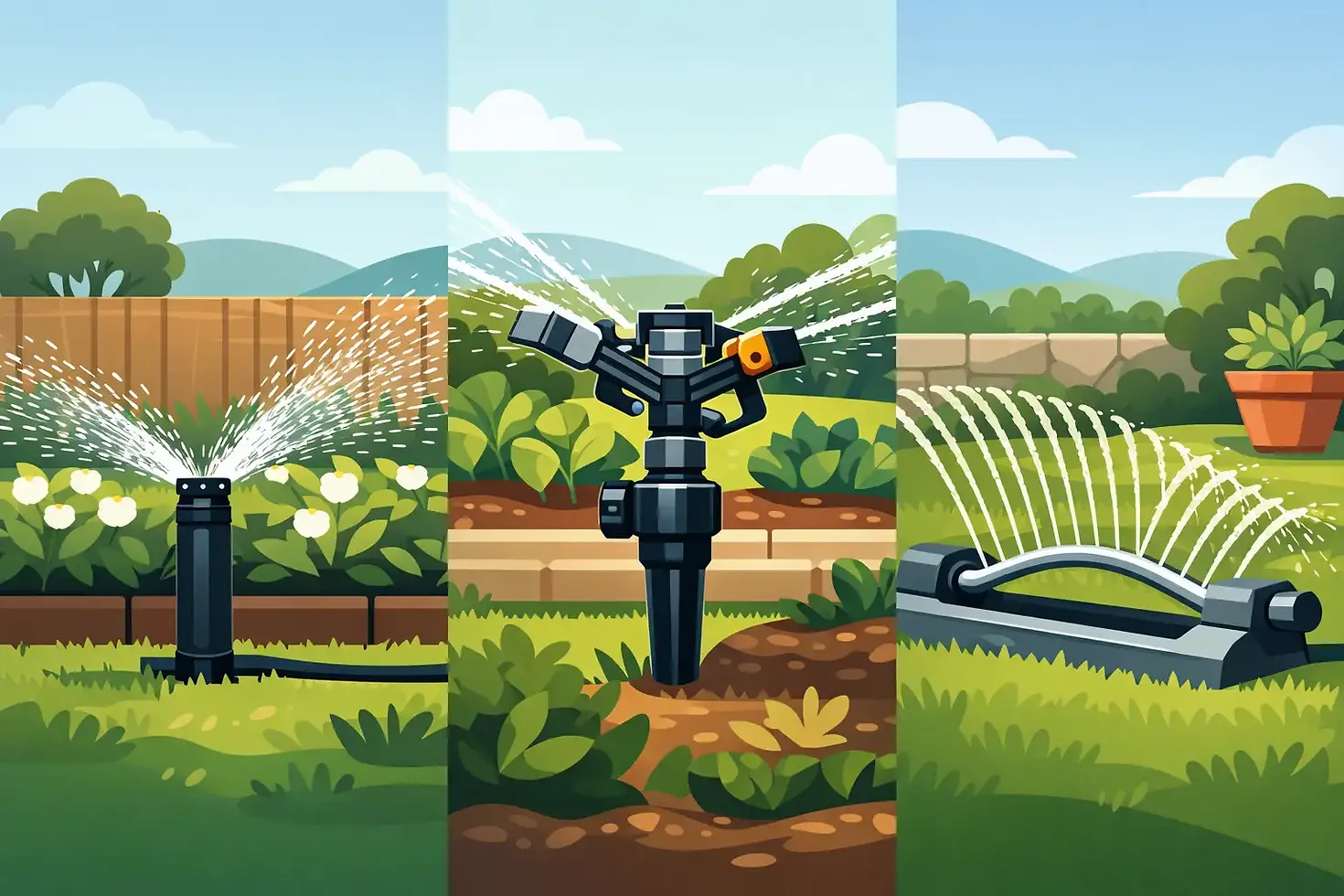
Best Sprinkler Heads for Gardens Compared

A sprinkler head that is excellent for a large, open lawn can be entirely wrong beside a rose border, beneath mature trees or along a narrow path. Choosing the best sprinkler heads for gardens is therefore not a matter of selecting one premium component. It is about matching the right nozzle, pressure and coverage pattern to every part of the landscape, then ensuring the whole system works together accurately.
For high-quality gardens, the result should be discreet, even and dependable. Lawns receive the water they need without dry patches or overspray, planting beds are protected from unnecessary wetting, and the garden retains its considered appearance without hoses, temporary sprinklers or visible pipework.
What makes the best sprinkler heads for gardens?
The best sprinkler heads are those specified as part of a properly engineered irrigation design. Their performance depends on more than the head itself: available water pressure, flow rate, pipe sizing, soil type, planting density, level changes and the shape of each watering zone all affect the final result.
A well-designed system uses matched precipitation rates. Put simply, the sprinkler heads within a lawn zone should apply water at a consistent rate, even if their arcs differ. A full-circle head, a half-circle head and a quarter-circle head may all be required around the lawn perimeter, but they must be selected and calibrated so that each area receives balanced coverage.
This is where an off-the-shelf approach often falls short. A garden may look rectangular on a plan, yet feature curved borders, paving, retaining walls, specimen planting and shaded sections that all require more considered design. Precision engineering avoids the common problems of misting, runoff, soaked paths and uneven turf growth.
Pop-up rotary sprinklers for established lawns
For most residential lawns, pop-up rotary sprinklers are the preferred solution. When inactive, they sit below ground level and preserve a clean, uncluttered finish. When the programme runs, they rise to deliver measured water across the lawn before retracting again.
Rotary heads apply water more slowly than conventional fixed-spray heads. That makes them particularly effective on slopes, compacted ground and heavier soils, where a rapid application can cause water to run across the surface rather than soak into the root zone. Their lower application rate gives the soil time to absorb moisture and reduces waste.
They are also well suited to larger lawn areas. Modern rotary nozzles can provide excellent uniformity over a broad radius while using water efficiently. However, they are not automatically the best choice for every lawn. Small, intricate areas may require a shorter-throw nozzle or a different head type to prevent water reaching hard landscaping, fencing or neighbouring property.
The final layout should account for head-to-head coverage. Each sprinkler’s throw should reach the next head, helping maintain consistent distribution across the entire turf area. This detail is fundamental to a healthy lawn and is one reason professional system mapping matters.
When fixed-spray heads are appropriate
Fixed-spray pop-up heads have a useful role in compact lawn sections and confined spaces where a rotary nozzle cannot perform at its intended radius. They provide a defined fan of water and can be configured for corners, narrow strips and awkward boundaries.
Their trade-off is speed. Spray heads apply water relatively quickly, so they must be carefully zoned and timed, particularly where soil is clay-heavy or ground falls away from the house. They should not be casually mixed with rotary sprinklers on the same zone, as the differing precipitation rates can create overwatered and underwatered areas.
Drip lines are usually best for borders
Sprinkler heads are not the answer for every planted area. For flower beds, hedging, shrub borders and kitchen gardens, drip irrigation is often the more effective and water-conscious choice. It delivers water slowly at ground level, close to the roots, rather than wetting foliage and surrounding surfaces.
This matters in well-planted gardens. Repeatedly spraying leaves and blooms can be inefficient, encourage disease in some planting schemes and leave paving unnecessarily wet. Drip lines also work quietly out of sight beneath mulch or within the soil profile, protecting the visual quality of a formal border or contemporary landscape.
A bespoke system may combine pop-up lawn sprinklers with dripline zones and micro-sprayers for more specialised areas. Each zone can then be programmed around the needs of the plants it serves. A newly planted hedge, for example, has very different watering requirements from established lawn or drought-tolerant Mediterranean planting.
Micro-sprayers for delicate and irregular planting
Micro-sprayers are valuable where planting needs a gentler, localised application of water. They can suit greenhouse edges, densely planted beds, groundcover, containers integrated into the landscape and irregular areas where conventional pop-ups would waste water.
They require careful placement. Installed too close together or with insufficient pressure regulation, micro-sprayers can over-saturate part of a border while leaving another section dry. They are most effective as part of a designed low-volume zone with the correct filtration and pressure control.
For larger estates or layered gardens, this level of zoning is especially useful. It allows lawn, formal beds, woodland margins and productive planting to be watered independently rather than forced into a single, unsuitable schedule.
The details that determine long-term performance
High-grade sprinkler heads are important, but the components behind them are equally significant. Pressure-regulated bodies, durable seals, correctly sized valves, filtration and reliable controllers all contribute to consistent performance over time.
Pressure regulation helps prevent fine mist being carried off by wind, particularly in exposed gardens. It also supports more accurate nozzle performance, ensuring the planned watering radius remains close to the installed reality. In areas with variable supply pressure, this is not a minor refinement - it is central to water efficiency.
Nozzles should also be selected for their arc and radius rather than adjusted beyond their useful operating range. A head intended to throw several metres should not be forced to water a very small section simply because it is available. The right component in the right location gives better coverage and a neater result.
A professional installation also considers access for future servicing. Pop-up heads need to remain level with the finished lawn, clear of thatch and soil, and positioned where mowing and edging will not damage them. Seasonal checks can identify blocked nozzles, settling ground, damaged heads or changes in planting before these affect the wider system.
Smart control makes good hardware more efficient
Even the best sprinkler heads for gardens can waste water if they are controlled poorly. A modern automated controller should divide the landscape into logical zones, run at suitable times and allow schedules to be adjusted as conditions change.
Early-morning irrigation is generally more efficient than watering during the heat of the day, when evaporation is higher. Yet the exact programme should reflect soil moisture, rainfall, shade, plant maturity and seasonal temperatures. A shaded lawn beneath established trees may need a very different schedule from an open south-facing area.
Rain sensing and seasonal adjustments provide further protection against unnecessary watering. For premium landscapes, the aim is not simply to irrigate more often. It is to apply the right volume, at the right time, in the right place.
Why a site survey should come before product selection
There is no universal list of sprinkler heads that suits every garden. The most appropriate solution comes from a site survey that assesses water supply, pressure, garden geometry, drainage, existing landscaping and the demands of different plant areas.
At Ideal Irrigation, this process informs a bespoke system map before installation begins. Pop-up sprinklers, drip lines and micro-sprayers are selected as a coordinated system, with durable components and discreet routing planned around the property. The installation can then be completed cleanly, commissioned accurately and supported by a market-leading two-year guarantee on new installations.
For homeowners and property managers, this means confidence that the lawn will be evenly covered, borders will receive suitable irrigation and water will not be wasted on paths, walls or areas that do not need it. It also means the system can be maintained and recalibrated as the garden matures.
The right sprinkler head should disappear into the landscape when it is not working and perform precisely when it is. That balance of discreet design, dependable coverage and smart water usage is what keeps a carefully designed garden looking its best through the season.


Comments